The 'Nice Watch' Problem: When Your Accessories Are Doing All the Heavy Lifting
That expensive watch on your wrist can't save an outfit that doesn't fit. Accessories should accent your style—not replace it.
I met a guy at a conference last year wearing a Patek Philippe on his wrist.
Beautiful piece. The kind of watch that costs more than most cars. Subtle enough that only people who know watches would recognize it. But if you know, you know. That's a six-figure timepiece.
He was also wearing a shirt that didn't fit, pants with a visible elastic waistband, and shoes that looked like they came free with a rental car.
And here's what I couldn't stop thinking: the watch made everything worse.
The Contrast Effect
When one element of your outfit is significantly higher quality than everything else, it doesn't elevate the rest. It exposes it.
This is basic visual psychology. Your brain makes relative judgments. When you see something expensive and refined next to something cheap and sloppy, the sloppy looks sloppier. The contrast is amplified.
That Patek wasn't making his outfit look better. It was highlighting exactly how little attention he'd paid to everything else. It was saying: "This man has resources and taste in one very specific category, and zero awareness everywhere else."
I've seen this pattern hundreds of times. Men who will drop thousands on a watch, a car, a pair of sunglasses—but won't spend an hour figuring out what shirt size they actually wear.
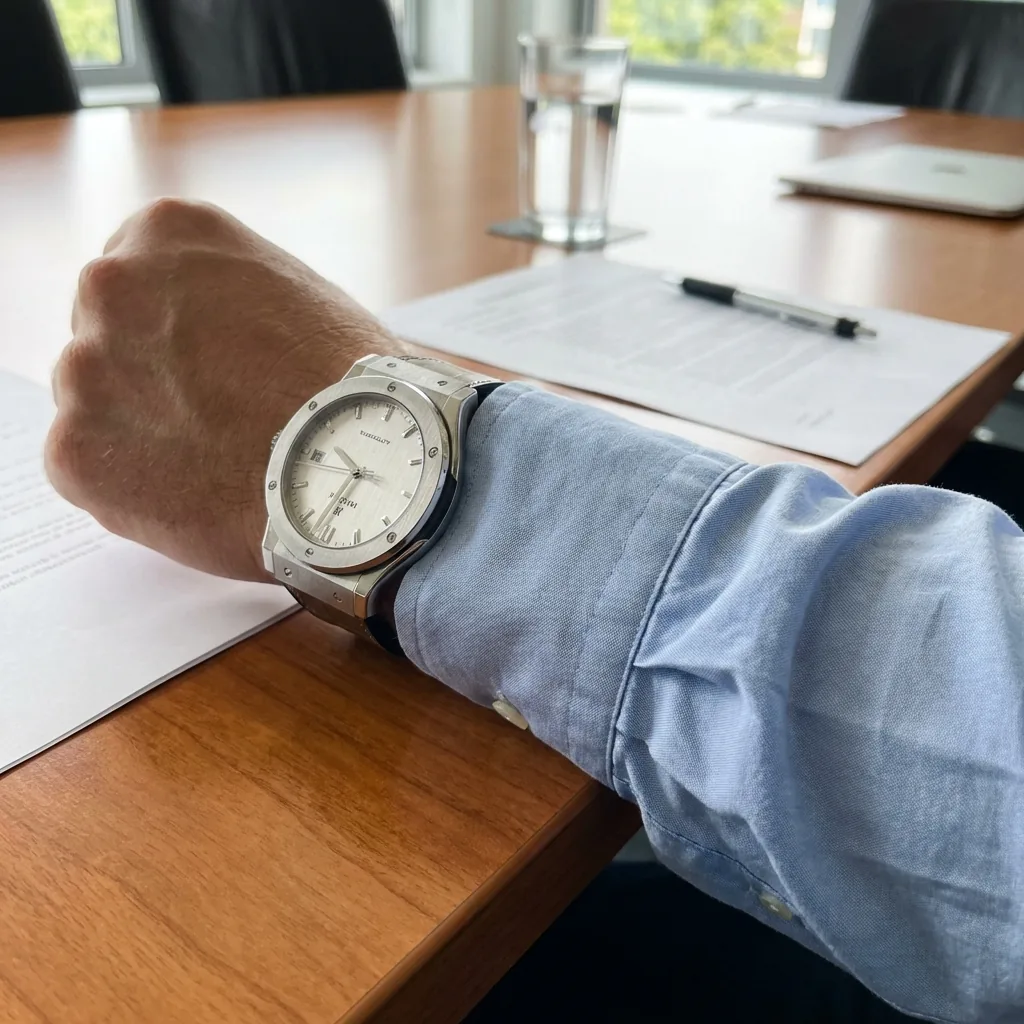
It's not a money problem. It's a priority problem. And the accessories are revealing it.
Why Men Default to Accessories
Here's what I think is happening.
Accessories are easy. They don't require fit. You don't need a tailor. You don't need to know your measurements or understand proportion or stand in a dressing room wondering if the shoulders are right.
A watch is a watch. You put it on. It looks the same on everyone. Same with sunglasses, cufflinks, tie clips, bracelets. One size. No ambiguity. No body-image complexity.
Clothes are hard. They require knowing your body—not just the number on a tape measure, but how fabric falls on your specific shape. They require decisions that feel subjective. They require maintenance, cleaning, tailoring, replacing.
So men who have money but not time or interest take the path of least resistance. They buy the best accessories they can afford and ignore the hard stuff.
And then they walk around broadcasting a very specific message: "I care about status symbols but not about how I actually look."
The Logo Trap
This isn't just about watches. It's about anything you wear primarily because it signals money.
The belt with the giant logo. The sneakers that are recognizable from fifty feet away. The sunglasses that announce their brand before you can see the lenses.
When the logo is the point, you're not dressing yourself. You're dressing your bank account. And everyone can tell.
Here's the test: Would you still wear it if no one recognized the brand? Would you still want it if the logo wasn't visible?
If the answer is no, you're not buying style. You're buying a receipt. And a receipt isn't a substitute for looking like you give a damn.
What Accessories Should Actually Do
Let me be clear: I'm not against accessories. A good watch is one of the few forms of jewelry men can wear without explanation. A quality belt, a pocket square, a solid pair of sunglasses—these are legitimate tools.
But they're supporting characters. Not leads.
An accessory should complement a foundation that's already working. It should add a detail that elevates an outfit from good to sharp. It should whisper, not shout.
A guy in a well-fitted navy suit with a clean white shirt and polished brown shoes can wear a simple steel watch and look like a million bucks. The watch is the period at the end of the sentence. It's not the sentence itself.

That same watch on a guy in a baggy polo and pleated khakis? It's punctuation with no sentence. It's trying to do a job it was never designed to do.
The Foundation-First Principle
If you're reading this and recognizing yourself, here's what I want you to understand:
Every dollar you spend on accessories before your foundation is right is a dollar wasted.
Your foundation is: clothes that fit. A shirt where the shoulders end at your shoulders. Pants that sit where they're supposed to and break cleanly at the ankle. Shoes that are clean and appropriate for the context.
This isn't expensive. A shirt that fits costs the same as a shirt that doesn't. Tailoring is $15-30 per item. Clean shoes require nothing but ten minutes and some basic supplies.
Once that foundation is solid—once you look put-together without any accessories at all—then you can add. Then the watch matters. Then the bracelet adds something instead of compensating for something.
But spending $8,000 on a watch when your shirts still billow at the waist? You're doing it backwards. And I promise the people noticing your watch are also noticing your shirts.
The Signaling Paradox
Here's something I've observed that might sting a little:
The men who wear the most conspicuous luxury accessories are rarely the ones who've actually arrived. They're the ones still trying to prove it.
Real wealth tends toward subtlety. Once you've had the Rolex for twenty years, you stop needing people to notice it. Once you've genuinely made it, you're not using your wrist to advertise.
The guy in the Patek with the rental-car shoes? He might have money. But he's signaling insecurity louder than he's signaling success. He needs you to see the watch. He needs you to know.
Quiet confidence doesn't require labels. It doesn't need a visible price tag. It's the guy in the unmarked but perfectly fitted jacket who looks expensive without announcing anything.
That's the version of yourself you should be building toward.
The Practical Upgrade Path
If you've been over-investing in accessories and under-investing in fundamentals, here's how to correct course:
Step one: Inventory your accessories.
Lay out everything you own that's not core clothing. Watches, bracelets, belts, sunglasses, jewelry. Look at what you've spent in total.
Now look at your closet. Have you invested anywhere close to that in actual clothes that fit? Be honest.
Step two: Audit your shirts.
Try on your five most-worn shirts. Stand in front of a mirror or, better, take a photo. Look at the shoulders—do they end at your natural shoulder? Look at the waist—is there billowing fabric or is there shape? Look at the sleeves—do they stop at the right point on your wrist?
If more than two of those shirts fail these tests, you don't have a wardrobe. You have fabric you put on your body.
Step three: Redirect the accessory budget.
The next time you're about to drop $500 on a watch, a bracelet, or a designer belt, ask yourself: Would that money make a bigger difference somewhere else?
$500 gets you three to four perfectly fitted shirts. It gets you two pairs of well-constructed chinos. It gets you a quality pair of leather shoes that will last a decade.
Those investments compound. They change how you look every day. A bracelet doesn't compound. It just sits there.
Step four: Apply the "without accessories" test.
Before adding any accessory to an outfit, look at yourself without it. Does the outfit work on its own? Is the fit clean? Are the proportions right?
If yes, the accessory will add something. If no, the accessory is a bandaid. And bandaids are visible.
The Watch Guys Will Disagree
I know this piece will irritate the watch collectors and accessory enthusiasts. They'll argue that a quality watch is an investment, a conversation piece, an heirloom.
They're not wrong.
But here's what they're missing: you can only make a first impression once. And when your first impression is "expensive watch, everything else an afterthought," no amount of horological passion changes that narrative.
A man who cares about his appearance cares about all of it. Not just the parts that come in nice boxes. Not just the pieces that required a decision at a boutique instead of a dressing room.
The watch should be the cherry on top of a sundae that's already beautiful. If it's the only good thing on the plate, you're serving garnish and calling it dinner.
The Shift I'm Actually Asking For
This isn't about spending less on accessories. It's about spending more attention everywhere else.
Get your fit right. Know what silhouette works on your body. Have shoes that match your clothes in quality and care. Then wear whatever watch you want. It'll actually look like it belongs on you.
One of my clients has a Rolex Submariner he's worn for thirty years. Inherited from his father. Means the world to him.
When he first came to me, it was the only good thing he had on. Now? Now it's the period at the end of a sentence that's already well-written. The watch didn't change. Everything around it did.
That's the goal. Not less watch. Better everything else.
If you've been over-investing in accessories and under-investing in foundation, a wardrobe audit shows you exactly where the gaps are. We look at what you own, what fits, and what's working against you—so you can start building in the right order.
Book Your AuditApply to be styled by me
Drop your info below and tell me what you're looking to achieve. I'll personally review your request and get back to you.
About the Author
Tess Gant
I help men over 40 rebuild their wardrobes and their confidence. No fluff, no judgment—just practical guidance that actually works. Whether you're recently divorced, back in the dating pool, or just ready to stop looking invisible, I've got you.
Learn more about my approachContinue Reading
More Articles
The Waiter Seated You in the Back. That Wasn't Random.
Restaurants, hotels, and stores are sorting you by appearance every time you walk in. You don't get to pick which category.
11 min readShe Swiped Right on the Other Guy. He Was Wearing Your Exact Outfit — It Just Fit.
Two men. Same outfit. Completely different results. The invisible difference that changed everything.
11 min readReady to Transform?
Look as Good as You Feel
Stop reading about style and start living it. Get your personalized wardrobe plan in 48 hours.
Get Your Reset — $397