The Case for Spending More on Less
Your closet is full of clothes you don't wear. Here's why buying fewer, better things will actually save you money.
I want you to do something uncomfortable.
Go to your closet. Count how many shirts you have. All of them—dress shirts, polos, t-shirts, everything.
Now count how many you actually wear on a regular basis.
If you're like most men I work with, there's a significant gap. You might own 40 shirts but rotate through the same 8. The other 32 are just... there. Taking up space. Representing money you spent on things that didn't work out.
This is the paradox of cheap clothing: it's actually expensive.
The Math Nobody Does
Let's say you buy a shirt for $30. Seems reasonable. It's from a decent mall brand, fits okay, looks fine on the rack.
You wear it three times. The collar starts to look weird after washing. The color fades faster than expected. It doesn't quite fit right and you can never figure out why. By month four, it's been relegated to "yard work only" status.
Cost per wear: $10.
Now let's say you buy a shirt for $120. Painful at checkout. But it's cut better, made from better fabric, finished more carefully. You wear it once a week for two years before it shows any signs of aging. That's roughly 100 wears.
Cost per wear: $1.20.
Which one was actually expensive?
This isn't theoretical. It's how wealthy people have been shopping for generations. They don't have more clothes than everyone else. They have fewer, better clothes that last longer and look better throughout their lifespan.
The rest of us fill our closets with compromises and wonder why nothing feels right.
Why Cheap Clothes Fail
I'm not being snobby here. I'm being practical. Let me explain what you're actually getting when you buy cheap.
The fabric is thinner.
That $25 sweater? Hold it up to the light. You can probably see through it. The yarns are spun thinner, the knit is looser, and the whole thing will pill after two washes. A quality sweater is denser, heavier, and maintains its shape.
The cut is generic.
Cheap brands use one or two patterns for all sizes. They just scale up the same shape. That's why a large shirt from a budget brand fits almost nobody well—it's not designed for actual body proportions.
Better brands use different patterns for different sizes, accounting for the fact that a large man isn't just a scaled-up medium man.
The finishing is rushed.
Check the seams on a cheap shirt versus an expensive one. The cheap one has loose threads, uneven stitching, maybe some bunching where pieces meet. The expensive one lies flat, every seam aligned.
These details seem minor until you're wearing the shirt and something doesn't feel right. Often you can't identify the problem—you just know you don't reach for that shirt.
It's designed to be replaced.
Fast fashion brands need you to keep buying. Their entire business model depends on clothes that look dated or fall apart within a season. They're not trying to make things that last. Why would they?
The Mindset Shift
Here's what I want you to consider:
Instead of asking "how much does this cost?" ask "how much will this cost per wear?"
Instead of "is this a good deal?" ask "will I actually wear this?"
Instead of "can I afford this?" ask "can I afford to keep buying things I don't wear?"
Most men I work with have spent more money on clothes they never wear than they would have spent just buying the right things in the first place.
The $30 shirt you wear three times costs more than the $120 shirt you wear a hundred times. The $150 shoes you replace every year cost more than the $400 shoes that last five years with proper care.
Cheap is expensive. Quality is economical.
What "Quality" Actually Means
I should define my terms, because "quality" gets thrown around a lot in menswear and sometimes it's just marketing.
Quality means:
Better materials. This doesn't always mean exotic materials—it means better versions of standard materials. Long-staple cotton instead of short-staple. Full-grain leather instead of corrected grain. Merino wool instead of acrylic blended mystery fiber.
Better construction. Seams that won't unravel. Buttons sewn on securely. Patterns that match at the seams. The small details that separate something made with care from something assembled as fast as possible.
Better fit. A well-designed garment that accounts for actual human body proportions. Room where you need it, tailoring where you want it.
Longevity. Materials and construction that will hold up over years, not months. Classics that won't look dated next season.
Quality does NOT necessarily mean:
- The most expensive option
- Designer labels
- Trendy brands with good marketing
- Anything with a visible logo

Some expensive clothes are poorly made. Some modestly priced clothes are excellent. Price is a rough indicator, not a guarantee. You have to learn to evaluate what you're actually buying.
The Practical Application
So how do you actually implement this?
Step one: Stop buying on impulse.
That "good deal" at the outlet mall? Walk away. The sale item you weren't looking for but seems too cheap to pass up? Leave it.
Impulse purchases are how closets fill up with regret. Every item should be intentional.
Step two: Identify gaps, not wants.
Before you buy anything, ask: what am I actually missing? Maybe you need a better navy blazer because yours is worn out. Maybe you need white sneakers because your only casual shoes are running shoes.
Buy to fill gaps. Not because something caught your eye.
Step three: Research before purchasing.
When you've identified a gap, spend time finding the right item to fill it. Read reviews. Look at different options at different price points. Understand what you're paying for and why.
This might take weeks for a significant purchase. That's fine. A considered purchase beats an impulsive one every time.
Step four: Buy the best you can reasonably afford.
Note: reasonably afford. I'm not saying go into debt for a jacket. But if your budget for a blazer is $200, consider saving for another month and getting something for $350 that will last twice as long.
The "I'll just get the cheaper one for now" mindset is how you end up buying the same category of item multiple times.
Step five: Take care of what you own.
Quality items need quality care. Learn to wash things properly. Get a shoe care kit. Find a good dry cleaner. Use cedar hangers.
Maintenance extends lifespan dramatically. A well-cared-for leather shoe can last decades. A neglected one dies in two years.
The Capsule Wardrobe Concept
This philosophy leads naturally to the idea of a capsule wardrobe: a smaller collection of versatile, high-quality pieces that all work together.
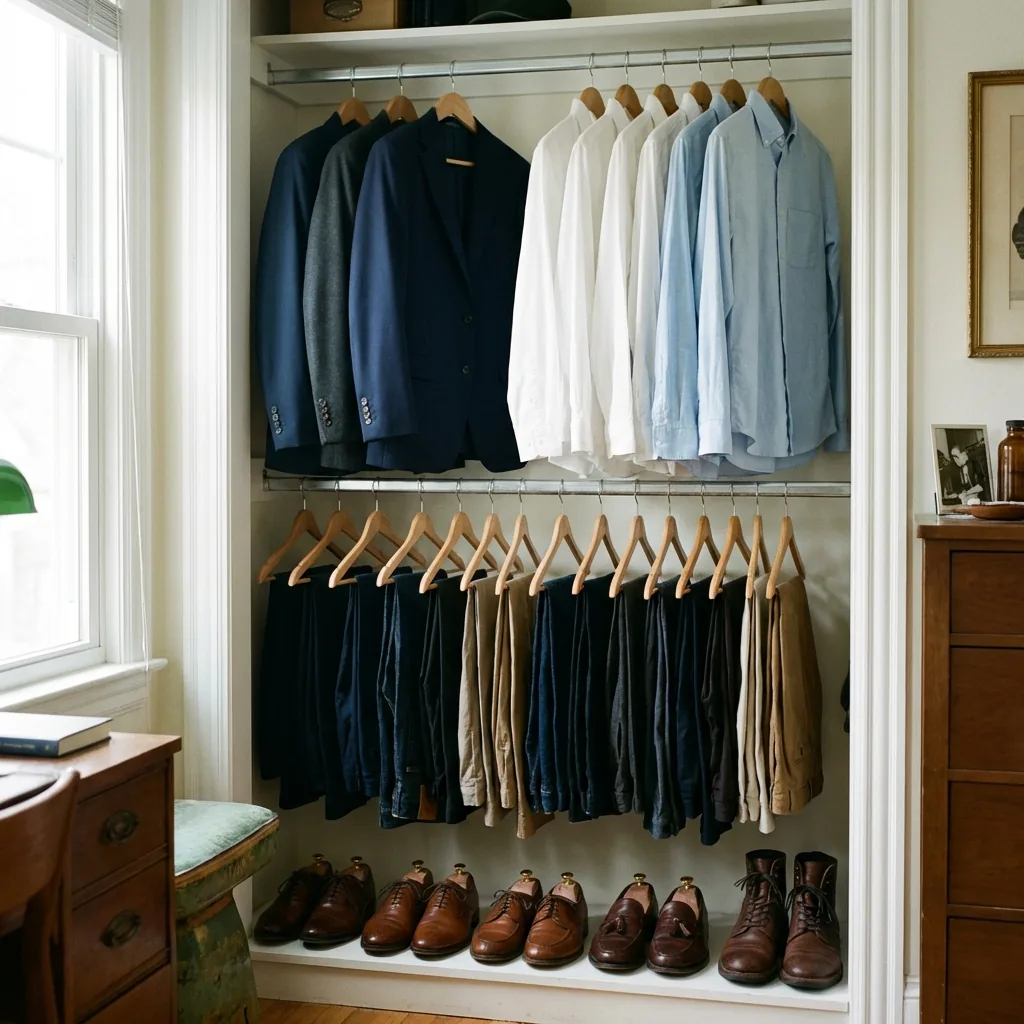
Instead of 40 shirts and nothing to wear, you have 10 shirts and endless options.
Instead of a closet stuffed with mediocrity, you have a curated selection of things you genuinely love putting on.
The math actually works in your favor. Spending $2,000 on 15 quality pieces that last five years is cheaper than spending $3,000 on 60 cheap pieces that need constant replacement.
And more importantly: you'll actually enjoy getting dressed. Every item will fit. Every combination will work. You'll open your closet and feel good about what you see.
That's worth something, even if you can't put a dollar figure on it.
One Final Thing
I know this is a lot to take in, especially if you've spent years shopping the "good deal" way.
You don't have to overhaul everything at once. Start with one category. Maybe it's shoes—buy one really good pair and experience the difference. Maybe it's a blazer you'll wear for years.
Let that piece teach you what quality feels like. How it drapes differently. How you feel differently wearing it. How it still looks great after months of use.
Then apply that standard to the next purchase. And the next.
Over time, your closet transforms. Fewer pieces, each one better. Less clutter, more confidence. Less spent overall, more value received.
That's the goal. Not more stuff. Better stuff. Stuff that actually works.
This is what The Overhaul is built around: a complete capsule wardrobe designed specifically for you. Every piece chosen for quality, fit, and versatility. Every combination guaranteed to work. No filler, no compromises, no regret purchases taking up space.
Build Your Capsule WardrobeApply to be styled by me
Drop your info below and tell me what you're looking to achieve. I'll personally review your request and get back to you.
About the Author
Tess Gant
I help men over 40 rebuild their wardrobes and their confidence. No fluff, no judgment—just practical guidance that actually works. Whether you're recently divorced, back in the dating pool, or just ready to stop looking invisible, I've got you.
Learn more about my approachContinue Reading
More Articles
The Waiter Seated You in the Back. That Wasn't Random.
Restaurants, hotels, and stores are sorting you by appearance every time you walk in. You don't get to pick which category.
11 min readShe Swiped Right on the Other Guy. He Was Wearing Your Exact Outfit — It Just Fit.
Two men. Same outfit. Completely different results. The invisible difference that changed everything.
11 min readReady to Transform?
Look as Good as You Feel
Stop reading about style and start living it. Get your personalized wardrobe plan in 48 hours.
Get Your Reset — $397