She Noticed Your Shoes First (What Your Footwear Says When You Walk Into a Room)
Before she saw your face, she saw your feet. Here's what different shoes communicate—and why most men are sending the wrong message.
There's a moment I witness constantly.
A man walks into a room—restaurant, office, party—and before anyone registers his face, his haircut, or his outfit, their eyes drop to his feet.
It happens fast. Half a second. Most people don't even realize they're doing it.
But they are. And what they see down there forms an impression that colors everything else.
I've asked dozens of women about this over the years. The response is almost universal: "I always notice shoes." When pressed on why, they struggle to articulate it. Something about attention to detail. Something about effort. Something about care.
Here's what I think is actually happening.
The Psychology of Looking Down
Shoes are the hardest part of an outfit to fake.
A guy can throw on a decent shirt and reasonable pants without much thought. But shoes require actual consideration. They require maintenance. They require knowing what goes with what.
When someone wears good shoes, it signals something deeper than fashion sense. It signals that they pay attention. That they think about the full picture. That they finish what they start.
When someone wears bad shoes—or even just forgettable shoes—it signals the opposite. That they got 90% of the way there and quit. That details don't matter to them. That "good enough" is their standard.
None of this is fair, by the way. But it's real.
There's research on this. A study from the University of Kansas found that people could accurately predict personality traits—including income level, attachment style, and even political affiliation—just from looking at someone's shoes. We're hardwired to read footwear as a proxy for character.
You can fight this reality or work with it. I suggest working with it.
The Shoes That Are Hurting You
Let me just run through the footwear I see men wearing that's actively working against them.
Running Shoes for Non-Running Activities
This is the big one.
I see men in restaurants, at their kids' school events, meeting friends for dinner—wearing running shoes. Not walking shoes. Not casual sneakers. Actual technical running shoes with mesh uppers and neon accents.
These shoes are designed for one purpose: running. When you wear them to do anything else, you look like either you just came from the gym (you didn't) or you don't own any other shoes (you probably don't).
Running shoes have their place. That place is running.
The Square-Toe Dress Shoe
If you bought dress shoes any time between 1998 and 2010, there's a good chance they have square toes. That was the trend. Every department store pushed them.
The trend is over. Has been for fifteen years.
Square-toe dress shoes now look dated in a way that's hard to describe but easy to feel. They're in the same category as pleated pants and oversized suits—relics of a specific era that say "I stopped paying attention."
Round toe or slightly almond-shaped. That's where you want to be.
Beat-Up Leather That Was Never Good
There's a difference between leather shoes that have developed character through years of wear and cheap leather shoes that just look destroyed.
Good leather ages. It develops patina. The creases tell a story.
Bad leather cracks. It flakes. It looks like it's dying a slow, visible death.
If your dress shoes are peeling, flaking, or have creases that look like canyons—they're not adding character. They're subtracting from everything else you're wearing.
The Hybrid That Doesn't Commit
You know the shoe I'm talking about. It's trying to be a dress shoe and a sneaker at the same time. Leather upper, chunky rubber sole. Looks like it can't decide what it wants to be when it grows up.
These shoes exist because men want to be comfortable but know they should be wearing something more polished. The compromise satisfies neither goal.
Either wear a real dress shoe or wear a proper sneaker. Commit to something.
Sandals in Non-Beach Contexts
I'm not going to tell you never to wear sandals. If you're at the beach, at a resort, or walking around a coastal town on vacation—fine.
But I've seen men in sandals at restaurants, at casual offices, at house parties. And every time, they look like they wandered in from somewhere else. Like they didn't realize this was a real occasion.
Showing your feet is a specific choice that limits where you can credibly be.
What Good Shoes Actually Look Like
Now let me tell you what to aim for.
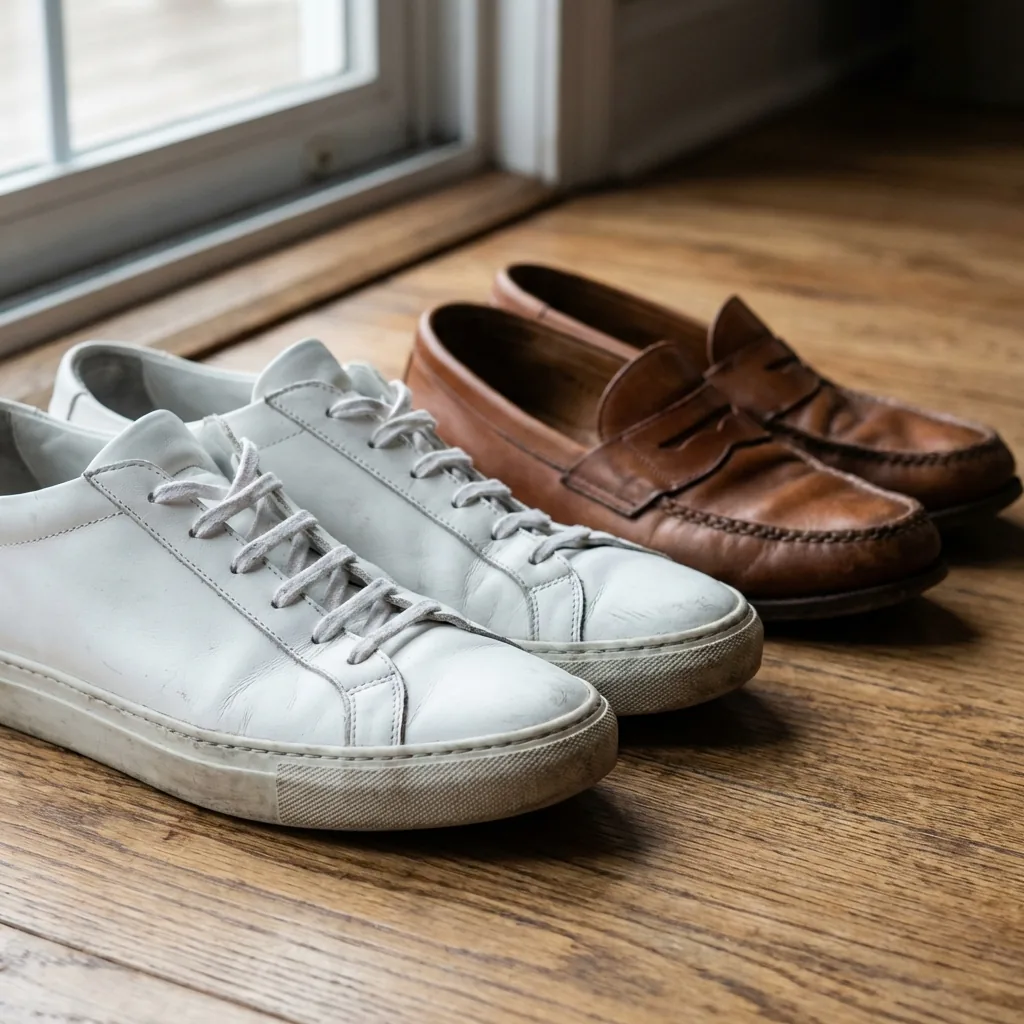
The White Leather Sneaker
This is probably the most versatile shoe a man can own right now.
Clean, minimalist, white leather. Not canvas (gets dirty too fast). Not chunky (reads too sporty). Just simple, streamlined white leather.
This shoe works with jeans. Works with chinos. Works with casual suits in the right setting. It's the one sneaker that doesn't read as "I gave up on real shoes"—it reads as an intentional choice.
Common Projects set the template here, but you don't need to spend $400. Koio, Oliver Cabell, Beckett Simonon, even some Adidas and Cole Haan options hit the right notes.
The key is keeping them clean. White leather sneakers lose their power the moment they look neglected.
The Minimal Leather Dress Shoe
For more formal situations, you need a leather dress shoe with clean lines.
An oxford or a derby in dark brown or black. Cap toe or plain toe. Minimal stitching and detailing. Quality leather that you take care of.
This isn't exciting. It's not supposed to be. It's supposed to be invisible in the best way—shoes so appropriate and well-maintained that no one consciously notices them, they just feel that something is right.
The Suede Chelsea Boot
If you want something with more personality that still goes with most things, consider a suede Chelsea boot.
Tan or grey suede. Simple elastic sides. Slightly pointed toe without being aggressive about it.
This boot bridges casual and dressed-up better than almost any other shoe. Jeans to wool trousers. T-shirt to sport coat. It just works.
The suede reads as softer and more approachable than polished leather. It's a shoe that says "I put thought into this" without saying "I'm trying too hard."
The Penny Loafer
The loafer is having a moment, and it deserves it.
A penny loafer in brown or burgundy is the perfect smart-casual shoe. Dressier than a sneaker, less formal than an oxford. Slip-on for convenience. Timeless in a way that trends can't touch.
The key is fit. A loafer that's too big looks sloppy. It should hug your foot without pinching. And it should be unlined or half-lined for comfort without socks in warmer months.
The Maintenance Most Men Skip
Here's where you separate yourself from 90% of men: taking care of what you own.
A $150 shoe that's maintained will always look better than a $500 shoe that's neglected. Every time.
What maintenance actually means:
For leather shoes:
- Wipe them down after wearing with a soft cloth
- Use shoe trees to maintain shape (cedar absorbs moisture)
- Polish them every few weeks if they're dress shoes
- Condition the leather twice a year to prevent cracking
- Rotate them—don't wear the same pair two days in a row
For white sneakers:
- Clean scuffs immediately with a magic eraser or white shoe cleaner
- Treat them with a protector spray when new
- Replace laces when they get dingy (laces are cheap, new laces change everything)
For suede:
- Brush regularly with a suede brush
- Treat with waterproofing spray before wearing
- Address stains immediately—suede holds grudges
This takes ten minutes a week, maybe. But those ten minutes are the difference between shoes that improve your whole look and shoes that drag everything down.

How Many Shoes Do You Actually Need?
Men tend to fall into two camps: own three pairs and wear them into the ground, or own thirty pairs and never wear half of them.
Neither is right.
Here's what I consider a functional shoe wardrobe for a man with a life that includes work, social events, and occasional dress-up occasions:
The Essential Shoe Rotation
- White leather sneakers - your casual workhorse
- Brown leather dress shoes - for anything requiring polish
- Loafers or Chelsea boots - the smart-casual bridge
- Clean casual sneakers in a neutral color - for weekends when white feels too precious
- Black dress shoes - for funerals, formal events, and certain professional contexts
That's five pairs. Maybe six if you add seasonal boots.
With those five, you can handle essentially any situation a modern man encounters. The key is that each one is quality enough to last and appropriate enough to serve its purpose well.
The Investment Mindset
I need to talk about price.
Good shoes aren't cheap. A proper pair of leather dress shoes starts around $250 and goes up from there. A solid leather sneaker runs $150-300. A quality loafer or boot is similar.
This stops a lot of men. They'd rather buy $60 shoes every year than $300 shoes once.
But the math doesn't work out in their favor.
A well-made, well-maintained leather shoe can last 10-15 years with resoling. That $300 shoe becomes $20-30 per year. The cheap shoe that falls apart in eighteen months is costing you more—and looking worse the entire time.
More importantly: cheap shoes look cheap. The leather is thin and plasticky. The construction is visible in all the wrong places. The proportions are slightly off.
You can feel the difference when you put them on. And everyone else can see the difference when you walk into the room.
This doesn't mean you need to spend $800 on designer footwear. But it means the $60 shoe section at the department store isn't where you want to be shopping.
Find the middle ground. Brands like Allen Edmonds, Meermin, Grant Stone, Thursday Boot Company—they're making legitimately good shoes in the $150-350 range. That's the sweet spot where quality meets accessibility.
The Final Word on Feet
I want to leave you with this thought.
Your outfit is a system. Every piece works with every other piece to create an overall impression. And in that system, shoes punch above their weight.
Get everything else right but wear bad shoes, and people notice. Wear a simple outfit with perfect shoes, and people assume the rest of you is just as considered.
It's not fair that such a small part of your appearance carries so much weight. But it does.
The good news is that shoes are a problem you can solve once and then maintain. Build a small rotation of quality footwear, take care of it, and you'll never think about this again.
Except when you walk into a room and notice how people respond to you. Then you'll think about it. But it'll feel good.
Not sure where your current shoes fall on the spectrum? Part of what I do is audit what you already own—including footwear—and tell you what's working, what needs to go, and exactly what to buy to fill the gaps. No more guessing.
Get Your AuditApply to be styled by me
Drop your info below and tell me what you're looking to achieve. I'll personally review your request and get back to you.
About the Author
Tess Gant
I help men over 40 rebuild their wardrobes and their confidence. No fluff, no judgment—just practical guidance that actually works. Whether you're recently divorced, back in the dating pool, or just ready to stop looking invisible, I've got you.
Learn more about my approachContinue Reading
More Articles
The Waiter Seated You in the Back. That Wasn't Random.
Restaurants, hotels, and stores are sorting you by appearance every time you walk in. You don't get to pick which category.
11 min readShe Swiped Right on the Other Guy. He Was Wearing Your Exact Outfit — It Just Fit.
Two men. Same outfit. Completely different results. The invisible difference that changed everything.
11 min readReady to Transform?
Look as Good as You Feel
Stop reading about style and start living it. Get your personalized wardrobe plan in 48 hours.
Get Your Reset — $397